Introduction
GNUS.ai brings together SuperGenius, a distributed compute and settlement runtime, and Genius Cognitive System (GCS), a modular AI architecture. Devices and applications can use local resources or, when suitable, a distributed network. The GNUS token supports network accounting and settlement; this is distinct from whether the native public mainnet has launched.
Two complementary systems
- SuperGenius / GNUS infrastructure: Device participation, peer-to-peer communication, distributed job execution, ledger, verification support, and settlement. Application developers normally integrate through the GeniusSDK or approved service interfaces.
- GCS cognitive architecture: A Semantic Core works with routed Expert Language Models (ELMs), a planner/controller, grounding, tools, and GAML memory. GCS selects and checks the work needed for a request rather than treating every request as one monolithic model call.
For example, a coding request may call a compact domain expert, consult scoped project memory, and request validation. Whether those operations run locally, on a private network, or on GNUS nodes depends on policy, resources, and readiness. GCS cognition is not the same as network job verification.
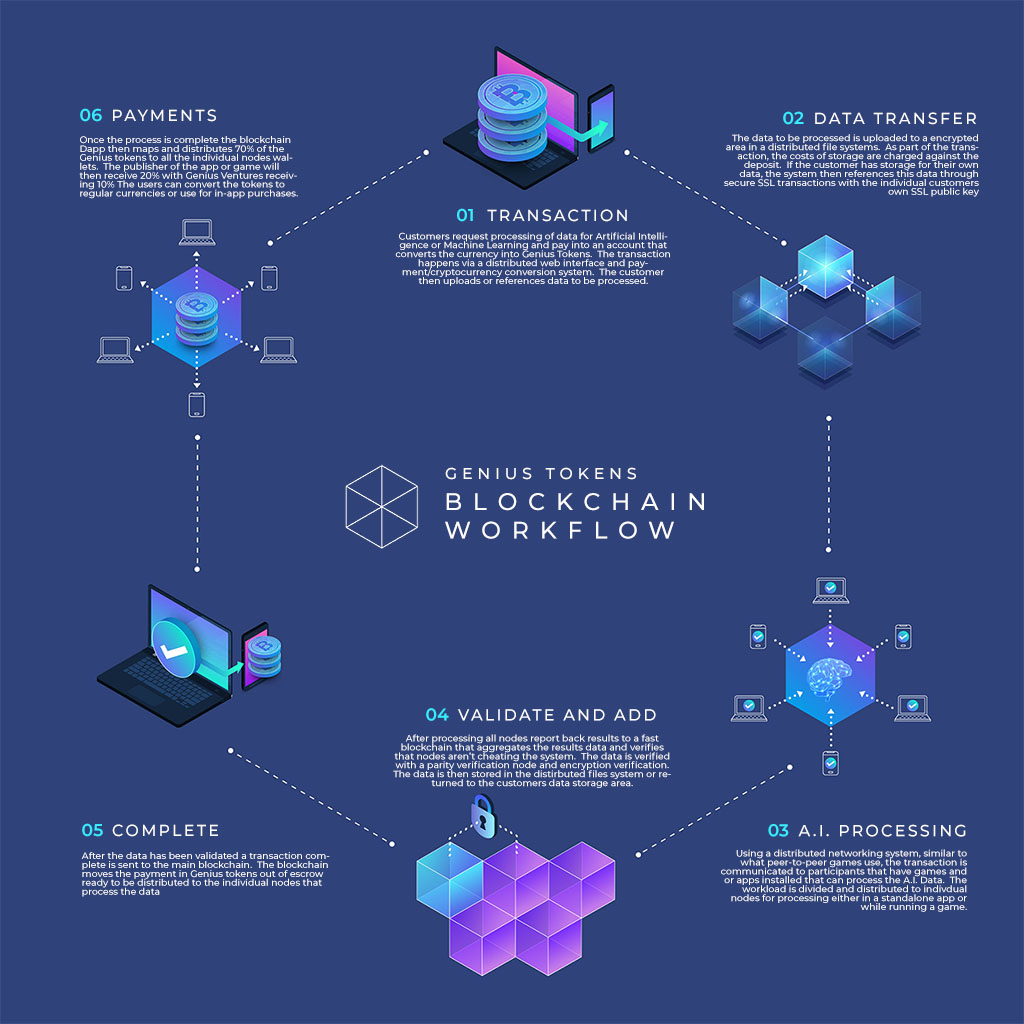
Earlier GNUS blockchain workflow illustration; see the Master Architecture for the current platform ownership map.
Purpose and mission
GNUS.ai aims to make specialized AI execution affordable and available on hardware people and organizations already own. Participating devices can contribute eligible work to the network; reward eligibility depends on the deployed network and application rules. Public mainnet rewards should not be assumed available before launch.
Release status
As of October 2026, the SuperGenius mainnet implementation is complete, but public mainnet is not live. GNUS.ai is preparing GCS, Genius AI Boss, and other launch applications for coordinated activation. No revised public-launch date is stated.
Read Platform Status, the Master Platform Architecture, and the GCS documentation.