Tokenomics
Disclosure of Funds Raised, Token Distributions, and Funds Usage
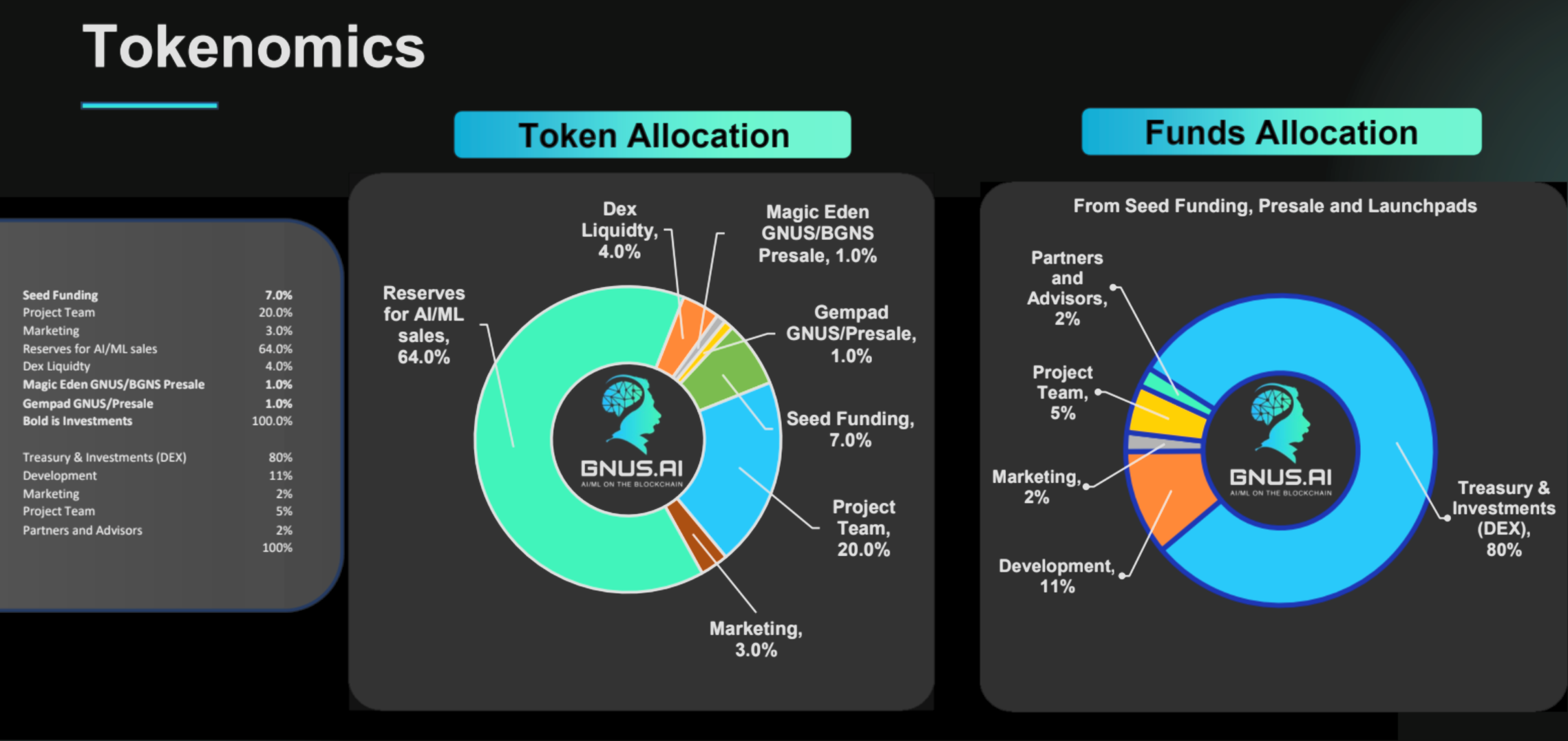
Tokenomics for Token Raise Distribution
Compute-Driven Token Growth
The following graph shows our Monte Carlo simulation using two Enterprises buying AI/ML processing and three games with 12 online players.
- Multiple Revenue Streams
- AI/ML Processing revenue, as well as Crypto & NFT trading fee revenue
- Crypto Token Advantages
- Mint & Burn allows configurable profits.
- Investments Scale the Network
- Investments are used to scale the network by adding nodes.
- Monte Carlo Analysis Simulation
- Monte Carlo Analysis shows the network effect. Faster network scaling increases GNUS token price faster.
.png)
Compute-Driven Token Growth over 700 days
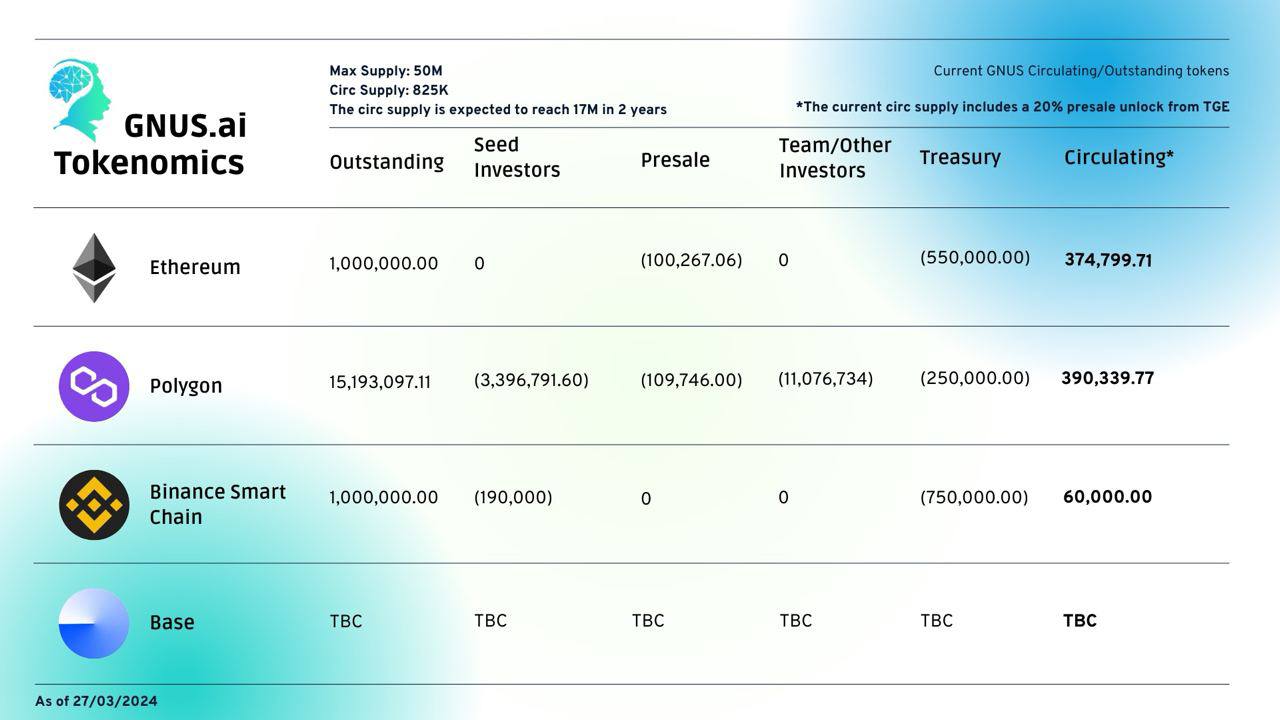
Circulating Supply
The GNUS token is subdivided into units called Minions. The current SuperGenius TokenAmount implementation represents 1 GNUS as 1,000,000 Minions (six decimal places) using an unsigned 64-bit integer. The earlier nine-decimal and 18.4-billion-GNUS-per-wallet figures are outdated for that internal representation. Confirm the precision used by each EVM token contract separately; the native ledger unit does not determine ERC-20 or ERC-1155 decimals.
Native processing burn configuration: The SuperGenius BurnConfig implementation defines a 100-basis-point (1%) genesis default, with quorum-controlled changes by trusted peers. It does not establish a fixed 10% burn for every processing payout. A default is not proof of the current live network setting.
Separate EVM contract burns: The EVM token-contract source also burns GNUS to create certain child tokens, burns source-chain tokens during bridging, and burns child tokens during redemption. These are conversion or transfer mechanisms, not the native processing-payout percentage. A bridge burn may be offset by a destination mint. See the FAQ and EVM contract source for the distinction. None of these burns, by themselves, guarantee an increase in token price.
See Platform Status for the distinction between completed native mainnet implementation and public activation.